Britain’s Export Blind Spot
To build a future-ready economy Britain, and every other nation, must rethink not just how much it exports, but what value those exports represent, and for whom.

The value of exports is a crucial indicator of a nation’s economic health and a vital engine for long-term prosperity. Exports bring external income into the economy, support domestic employment, stimulate innovation, and underpin the development of productive capabilities. As the world becomes more interconnected, the capacity to create value that is desired abroad, and competitively delivered, is fundamental to national strength and resilience.
But exports are not just about quantities shipped or trade balances. What matters is the nature of that value, how it is created, and who ultimately benefits from it. That, in turn, demands a re-examination of the assumptions behind Britain’s trade and industrial strategies.
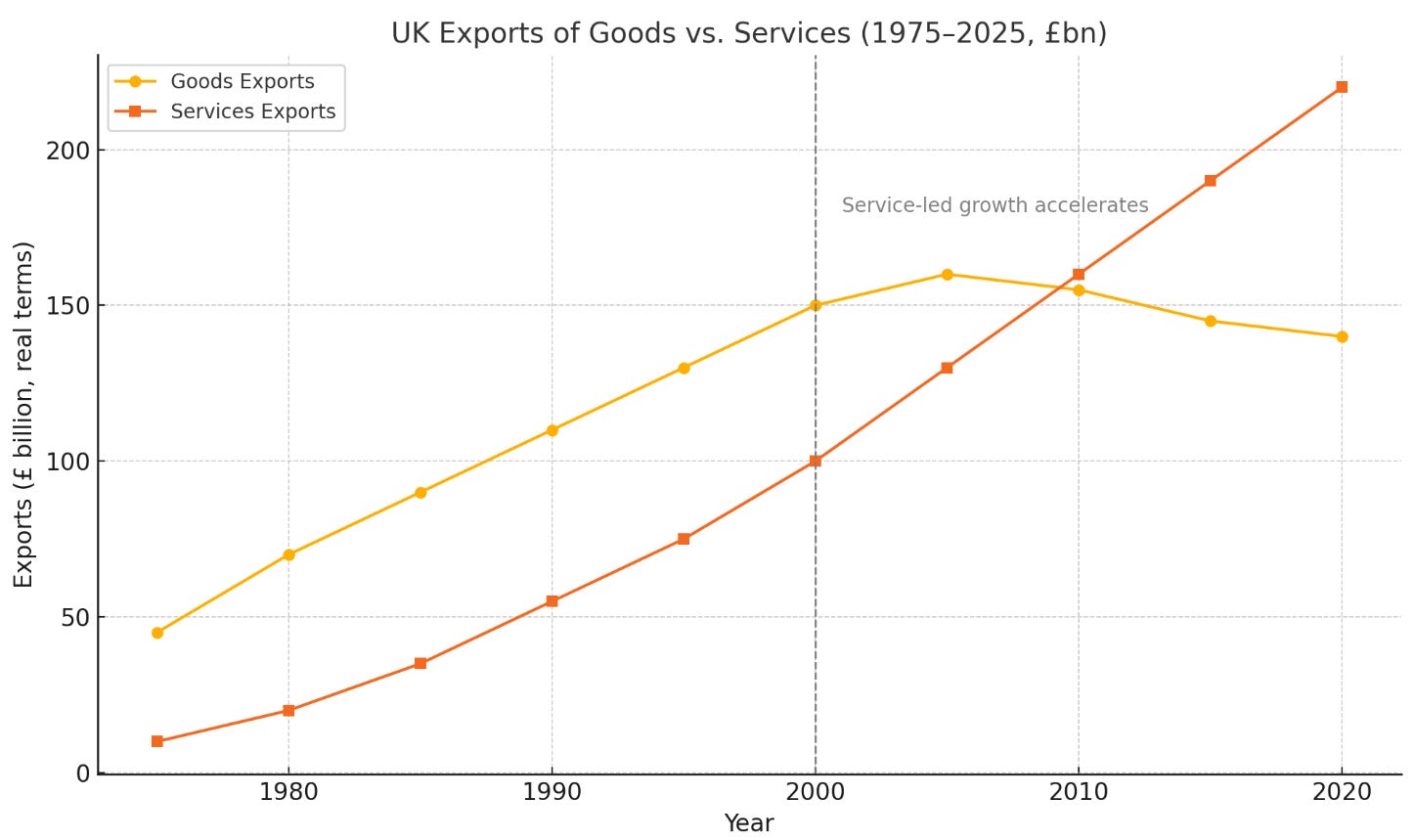
Martin Wolf’s recent Financial Times column, "The UK’s trade performance remains dire" (May 26, 2025), captures the extent of Britain's current challenge. He points to a 20% fall in goods exports between 2019 and 2024 and describes how, for the first time in decades, exports have become a net drag on economic growth. His diagnosis is compelling, rooted in decades of analytical expertise. Yet, while his focus on the UK’s worsening trade in goods is well-founded, it also opens the door to a broader and more timely inquiry: what is the UK actually producing of value in the 21st century? And for whom?
Beyond Industrial Nostalgia
For decades, successive governments have pursued variations of a national industrial strategy, each attempting to reinvigorate the UK’s economic competitiveness through infrastructure spending, skills programmes, tax incentives, or sectoral interventions. Yet few of these efforts have yielded the hoped-for transformation. One reason may lie in the title itself: "industrial strategy,"a phrase rooted in a 20th-century conception of economic value.
The term ‘industry’ can, of course, be applied to any sector, and often is. But it is traditionally associated with the manufacture of goods and services and a tighter definition may give clarity to the conversations that need to be had.
In today's world, where services account for over 80% of UK GDP and nearly half of exports, a framework that prioritises physical manufacturing and goods-based trade risks overlooking where the country’s most dynamic value creation now resides.